
We’ve all been there. The category review that concludes with “the market is saturated.” The innovation workshop that produces yet another incremental feature in a crowded and mature category. The development cycle that stretches on because no one can agree on priorities.
But what if the very tensions that seem to block progress are actually showing us the way forward?
The Hidden “Insight Gold” in Consumer Compromises
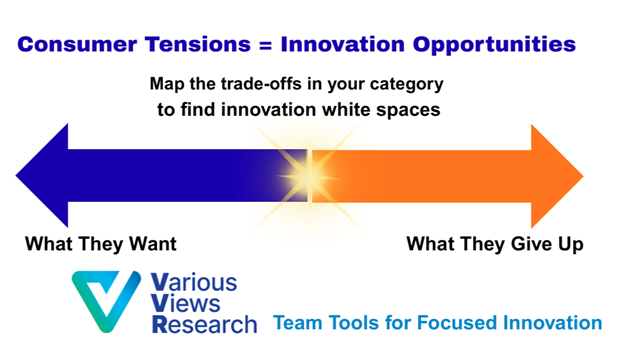
Here’s a truth that many innovation teams overlook: every compromise a consumer makes is a potential innovation opportunity pointing directly at unmet needs.
When someone chooses a product despite its limitations, they’re not just accepting trade-offs they’re telling you exactly what’s missing in your category.
I recently worked with a team convinced their category was completely tapped out. Premium players owned quality. Value brands owned price. Mid-tier options competed on endless feature variations. Where could innovation possibly come from?
The breakthrough came when we reframed the question and stopped looking at what products offered and started mapping what consumers were giving up.
We discovered something fascinating: consumers in this “mature” category were making the same painful trade-off over and over. And they’d become so accustomed to this choice that they’d stopped expecting anything different.
That resignation? That’s your white space.
By deeply analyzing these compromises, not through traditional feature-benefit analysis, but by understanding the emotional and practical tensions in consumers’ lives, the team identified a breakthrough positioning that created an entirely new segment in a supposedly saturated market.
How Trade-Off Analysis Accelerates Development
The second power of trade-off thinking is less obvious but equally transformative: it dramatically compresses your development timeline.
Here’s why: Most teams spend months debating which attributes matter most, testing endless variations, and trying to optimize everything. This approach treats all product dimensions as equally important, which means you’re burning time and resources on features that may never drive purchase decisions.
When you start with consumer trade-offs, you immediately know which attributes are truly valued because you can see which attributes or benefits consumers are already willing to sacrifice.
One team I worked with was six months into developing a product with twelve distinct features, constantly iterating and testing. When we mapped the actual trade-offs in the category, three features emerged as critically important and they were the ones consumers were consistently sacrificing other benefits to obtain.
The team refocused exclusively on those three dimensions. Development time dropped by 40%. And the final product performed significantly better in market because it delivered exceptional value where it truly mattered.
From Feature Lists to Tension Maps
So how do you actually apply this thinking?
Stop asking: “What features do consumers want?”
Start asking: “What are consumers giving up right now, and why?”
The questions shift from preferences to priorities:
- What trade-offs do they make reluctantly versus willingly?
- Which compromises do they rationalize, and which genuinely frustrate them?
- What would they refuse to sacrifice, even for significant gains elsewhere?
- What would they wish for and why that seems impossible today?
These questions reveal the architecture of value in your category and where that architecture is fundamentally broken.
The Rich Landscape of Consumer Tensions
While price versus quality might be the most obvious trade-off, the most valuable innovations often come from resolving tensions that run much deeper. Below are some examples of compromises that can help create breakthrough opportunities:
Performance vs. Simplicity
The powerful tool that requires expertise versus the simple one that limits what you can do. Think professional-grade cameras versus smartphone photography until smartphones got good enough that the trade-off started to dissolve.
Speed vs. Control
Fast and automated versus slower but customizable. Meal kits solved this beautifully because they are faster than cooking from scratch, but more control than takeout.
Effectiveness vs. Safety/Gentleness
The cleaning product that works but damages surfaces. The medication that treats symptoms but has side effects. The skincare that delivers results but irritates sensitive skin.
Sustainability vs. Performance
Eco-friendly options that don’t work as well, or effective products that create guilt. This tension is reshaping entire categories as consumers increasingly refuse to choose.
Personal Expression vs. Social Acceptance
Standing out versus fitting in. Categories from fashion to technology constantly navigate this tension. Should I make the bold choice that risks judgment versus the safe choice that feels invisible?
Privacy vs. Personalization
Sharing data for better experiences versus maintaining control over personal information. Every digital service wrestles with this balance.
Health vs. Pleasure
The nutritious option that doesn’t taste good versus the indulgent choice that comes with guilt. Categories that resolve this tension create loyal followings.
Timesaving vs. Quality of Experience
Efficiency that feels transactional versus slower approaches that feel meaningful. Why do people still prefer dining out over meal delivery, despite the time cost?
Durability vs. Aesthetics
Built to last but looks utilitarian versus beautiful but fragile. Apple’s design philosophy was partly built on refusing this trade-off.
Versatility vs. Specialization
The all-in-one tool that does everything adequately versus specialized tools that excel at one thing. This creates natural segmentation opportunities.
Transparency vs. Complexity
Understanding how something works versus trusting a “black box” that works better. Consumers increasingly demand both and particularly in categories like finance and healthcare.
Immediate Results vs. Long-Term Benefits
The quick fix that doesn’t last versus the sustainable approach that requires patience. Fitness, finance, and education categories live in this tension constantly.
A Practical Guide to Mapping Consumer Trade-Offs
Ready to uncover the tensions in your category? Here’s how to get started:
- Listen for the “But” Statements
In consumer conversations, the word “but” is golden. “I love this brand, but it’s expensive.” “It’s convenient, but the quality isn’t great.” These statements reveal active tensions. Create a simple log of every “but” you hear and the patterns will emerge quickly. - Map the Consumer Journey: From Unboxing to Everyday Reality
The most revealing tensions don’t appear at checkout; they emerge during actual use. Taking time to understand and observe behaviors post product purchase can often reveal the tensions and trade-offs being made. Identify and map the tensions across the entire product use journey.- The First Use: What compromises become immediately obvious? The premium cooler owner struggling to lift it when fully loaded. The budget buyer noticing ice melting faster than expected on that first beach trip.
- Repeated Use: Which trade-offs turn from minor annoyances to deal-breakers? The high-performance rotomolded cooler that’s bulletproof but requires two people to move. The lighter model that seemed “good enough” but now means refilling ice twice during every camping weekend.
- Storage & Maintenance: What sacrifices frustrate consumers between uses? The cooler with incredible insulation that dominates a whole shelf in the garage year-round. The compact option that fits perfectly in storage but leaves you wishing you had more capacity every summer.
These recurring friction points are the daily reminders of what they gave up will reveal which trade-offs sting most. And more importantly, which one’s consumers would pay to eliminate.
- Study Switching Behavior
Why do consumers switch between brands or products in your category? Switchers are making visible trade-offs. They’re choosing to give up something they had to gain something they didn’t. Track the pattern of sacrifices in switching behavior as it reveals which attributes create enough tension to trigger change. - Identify the “Resignation Points”
Ask consumers: “What would your ideal product do that nothing currently does?” Then ask: “Why don’t you expect that to exist?” The gap between desire and expectation shows where they’ve resigned themselves to trade-offs. Resignation is opportunity. - Create a Trade-Off MatrixBuild a simple 2×2 framework:
- Willing Sacrifices: What consumers readily give up (low priority)
- Reluctant Sacrifices: What they wish they didn’t have to give up (innovation opportunity)
- Non-Negotiables: What they refuse to sacrifice (table stakes)
- Aspirational Additions: What they’d love to gain without sacrifice (potential differentiation)
Plot your current offerings and competitive products on this matrix and the white space(s) becomes visible.
- Use Forced Choice Exercises
Instead of asking what consumers want, force them to choose: “Would you rather have X or Y?” Then ask them to explain the choice. The explanation reveals the relative value and the pain of what they’re giving up. Run these exercises across multiple attribute pairs to build a hierarchy of what truly matters. - Watch for Workarounds
Consumers who create DIY solutions or combine multiple products are shouting about unresolved tensions. The person who buys the cheap version but immediately modifies it. The one who uses two different products to get what one product should deliver. These workarounds are innovation blueprints. - Analyze Complaint Patterns
Review customer service data, online reviews, and social media complaints. But don’t just catalog the problems, look for the underlying trade-off being lamented. “It broke after three months” might really mean “I chose price over durability and I regret it.”
The Counterintuitive Truth
The most crowded categories aren’t necessarily the ones with the most products. They’re often the ones where every product forces the same compromises.
And the fastest path to market isn’t eliminating every possible risk through exhaustive testing. It’s knowing with certainty which bets actually matter.
Consumer tensions, the trade-offs, the compromises, the reluctant choices aren’t obstacles to innovation. They’re the most precise map you’ll ever get to where real opportunities exist.
Are you stuck playing the “new feature game”? If so, maybe you should start looking at the real-life tensions and trade-offs that exist in your category? Identifying these might be exactly where your next breakthrough is hiding.