
Here’s a question: How many of you have ever taken a class on listening?
I’m guessing very few hands went up.
Yet listening is arguably the most-used, least taught skill in consumer insights, market research, and innovation. We spend our entire careers listening to consumers, to data, to markets, to teams. But unlike analysis, statistics, or presentation skills, listening is rarely taught. We just assume people know how to do it.
They don’t. And neither did I, until I started paying attention to how I was and wasn’t actually listening.
Early in my career, I had the privilege of taking a course that fundamentally changed how I approach consumer research and innovation. It was called “Listening Counts,” and it was developed by several brilliant product researchers at Procter & Gamble in the early 1990s.
Three Concepts That Changed Everything
What made this training remarkable wasn’t just the content, it was the vision behind it, built on three powerful and inseparable concepts.
Active Listening
Great consumer insights don’t come from asking better questions alone. They come from listening better to the answers. So, P&G trained their multi-functional teams alongside their qualitative research suppliers, creating a shared language and methodology that ensured everyone was fully present, catching not just what consumers said, but what they meant.
Heightened Observation
Listening alone isn’t enough if you aren’t equally attuned to what you’re seeing. The training challenged participants to slow down, deliberately and intentionally. Pay closer attention to the nuances and small details that are so easy to miss in the normal pace of a consumer interaction (the use of video absolutely helps with this). A slight hesitation. A change in energy. The way someone handles a product. The compensating behaviors they would never think to tell you. The moment their expression shifts before their words catch up. These are the little things that, when noticed and captured, often make the biggest difference in creating a truly better product experience.
Structured Team Debriefing
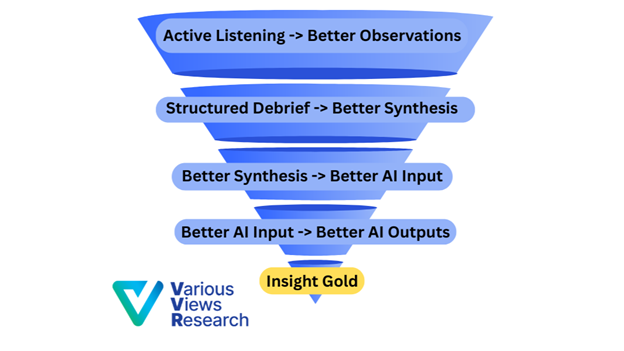
No single person, no matter how skilled, hears or sees everything. Each listener and observer brings their own perspective, filters, and focus to a consumer interaction. When you bring a multi-functional team together to debrief with intention and structure, you harness the collective power of everyone’s active listening and observational skills — and what emerges is a richer, more complete, and more nuanced picture of what consumers are truly communicating. Together, these three concepts changed everything. Active listening fills the room with signal. Heightened observation catches what words alone never could. And structured debriefing makes sure none of it gets lost.
Why Listening Matters Even More in the Age of AI
Decades later, those lessons remain more relevant than ever and in ways P&G’s researchers couldn’t have fully anticipated in the early 1990s. In an era of big data and AI-driven analytics, we’re swimming in information about what consumers do. But we’re often missing the deeper insights about why they do it. And here’s what most organizations are starting to realize as we learn to integrate AI tools into the research process: AI is only as powerful as the human insight it’s fed. When your team listens actively and debriefs with structure and intention, you don’t just capture better quotes and observations you generate richer, more nuanced, more precise inputs for AI analysis. Garbage in, garbage out has never been truer. The quality of what your AI surfaces is directly upstream from the quality of your listening. Better active listening produces better data. Better structured debriefing produces better synthesis. Together, they produce the kind of deep, layered consumer understanding that gives AI something genuinely powerful to work with, the why behind the what, the meaning behind the behavior. In a world where everyone has access to the same AI tools, the organizations that win won’t be the ones with the best algorithms. They’ll be the ones who gave those algorithms the best human listening to learn from.
The irony is that in at least some cases your customers may already giving you the roadmap for innovation and most organizations just aren’t listening and observing well enough to hear or see it.
The truth is nobody can listen and learn for you. You can read the transcript. Watch the recording. Review the summary. But true listening, the kind that uncovers insight, recognizes patterns, and catches what people mean versus what they say requires your full presence and attention. It’s a skill. And like any skill, it gets better with practice and self-awareness.
What is Active Listening?
Psychologists Carl Rogers and Richard Farson coined the term in 1957. Active listening is the intentional practice of being fully present in the moment, attending to what’s communicated both verbally and non-verbally, then reflecting that information back to ensure shared understanding and create connection.
The key insight being that most people don’t listen with the intent to understand; they listen with the intent to reply. Active listening flips that script.
Pro Tips for Becoming a Better Active Listener
- Notice your internal narrator: Pay attention to that voice in your head formulating your next question or judgment while someone is still talking. When you catch yourself doing this, pause and redirect your attention back to the speaker. You can’t listen and rehearse simultaneously.
- Get comfortable with silence: The best insights often come in the pause after someone thinks they’ve finished answering. Count to three before jumping in. Let them fill the space. You’ll be amazed what emerges when you stop rushing to the next question.
- Listen for emotion, not just information: What does their tone tell you? Where do they light up? Where do they hesitate? The how of what someone says is often more revealing than the what. Pay attention to energy shifts and body language.
- Separate observation from interpretation: Practice distinguishing “what I heard” from “what I think it means.” For example: “She said the product was ‘fine'” (observation) versus “She didn’t like it” (interpretation). Get good at catching yourself making leaps. Ask for clarification and resist the urge to fill in the blanks.
- Check your assumptions at the door: Before any conversation, ask yourself: What do I already believe about this? What am I hoping to hear? Knowing your bias helps you recognize when you’re filtering through it instead of truly listening.
- Reflect back what you heard: “So what I’m hearing is…” isn’t just a facilitation technique, it’s a check on your own listening. Paraphrasing what you’ve heard in your own words confirms you actually understood rather than assumed you did. This is the core practice of active listening. A particularly powerful variation: “Tell me more about [their exact words].” When someone mentions the product made them feel “overwhelmed,” don’t translate it in your head, use their language: “Tell me more about feeling overwhelmed.” This does two things simultaneously. First, it proves you’re truly listening by mirroring their exact words back to them. Second, it invites deeper exploration without imposing your interpretation or agenda. People often answer questions with minimal detail because they don’t want to bore you with information you might not care about. But when you echo their specific words or ideas, you signal genuine interest and give them permission to go deeper. This technique also keeps you anchored in the present moment of the conversation rather than mentally jumping ahead to your next pre-planned question.
- Practice listening to yourself first: How do you describe your experiences with products and brands? What words do you use? What matters to you? The more you get in tune with yourself and how you listen to your own internal dialogue, the better you’ll become at actively listening to your consumers.
Just like using your products creates empathy and understanding your biases creates a baseline for comparison (as I’ve written about recently), tuning into your own listening habits is the foundation for hearing others clearly.
Why Your Personality Matters: Active Listening Isn’t One-Size-Fits-All
One of the interesting insights from that “Listening Counts” training was recognizing that we all have natural listening strengths and blind spots. Your Myers-Briggs type and CliftonStrengths profile shape how you listen, what you hear, and what you might be missing.
Here are a few examples:
- If you’re an ENTJ: Your drive for efficiency is powerful, but it can make you rush to solutions before fully exploring the problem. Watchout: Mentally plotting next steps while the customer is still talking. Tip: Trust that better strategy comes from complete understanding and resist the urge to problem-solve until you’ve heard everything.
- If you’re an INFP: Your deep empathy helps customers open up, but your internal idealism might filter out contradictory realities. Watchout: Hearing what aligns with your vision of how things should be rather than how they actually are. Tip: Practice asking “What else?” even when you think you understand and especially when the answer might challenge your assumptions.
- If you have Analytical in your top strengths: Your ability to identify patterns is invaluable for innovation insights, but you can get stuck evaluating the logic of what’s being said rather than simply hearing it. Watchout: Questioning validity in real-time instead of collecting data. Tip: Save your analysis for after the conversation. First, just listen and capture everything.
- If you have Empathy in your top strengths: You naturally sense what customers are feeling, which builds incredible trust and opens doors to deeper insights. Watchout: Absorbing emotions so deeply that you lose objectivity or avoid probing sensitive topics. Tip: Use what you’re sensing to go deeper: “I sense you’re feeling frustrated about this. Tell me more about what’s driving that.”
- If you have Activator in your top strengths: Your bias toward action ensures insights lead to innovation, but it can make you rush to implementation before fully understanding the problem. Watchout: Cutting conversations short to “get moving.” Tip: Channel your urgency into thorough listening now as it makes your action later far more effective.
The difference between good insights and great insights often comes down to the quality of listening and observing what happened during whatever research is being conducted. That’s why post-interview debriefs with your cross-functional team are so critical. Each person’s unique listening profile catches what others miss. By comparing notes immediately after a session, you create a more complete picture than any single listener could capture alone
So, here’s my challenge: In your next conversation, whether it’s a consumer interview, a team meeting, or even a chat with a friend, pick one of these techniques and practice it deliberately and notice what changes.
Want personalized active listening strategies based on YOUR profile? Comment below, and I’ll send you the Myers-Briggs types and CliftonStrengths customized tips for becoming a better listener and ultimately, a better innovator. Understanding your natural tendencies is the first step to leveraging your strengths while compensating for your blind spots. This guide is a great pre-research tool to help your whole team better understand their own personal listening superpowers as well as their potential blind spots. Using this tip sheet before your next research event will help maximize your team’s ability to discover breakthrough, actionable insights.